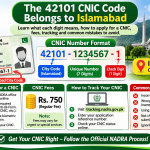

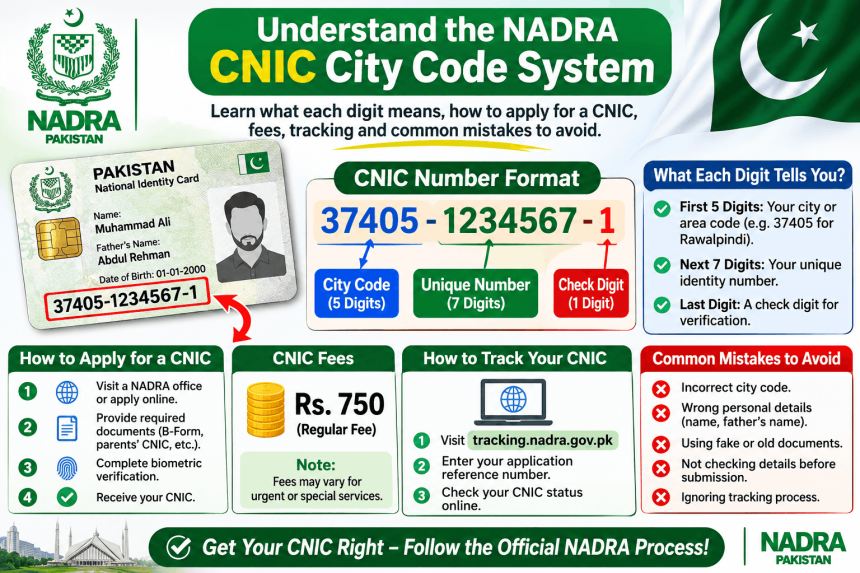
The first digit of your NADRA CNIC number shows your province or region. The second digit shows your division. The third, fourth and fifth digits identify your district, tehsil and union council. This is the practical “city code” system inside every 13-digit CNIC number. This guide explains how each digit works, what the codes mean, and how to apply for or renew your CNIC through NADRA.
What the NADRA CNIC city code actually is
NADRA does not publish a single public list called “city codes” in the way some people expect. Instead, the location information is built into the CNIC number itself .
Every CNIC follows this format: XXXXX-XXXXXXX-X.
The first five digits are the location block. They identify where the cardholder was registered. The middle seven digits are the family number. The final digit shows gender .
This means you can read a CNIC number to understand roughly where the person’s registration originates. You cannot, however, use it to track a current address or confirm where someone lives today.
The province codes: first digit of CNIC
The first digit tells you the province or region of registration .
| First Digit | Province or Region |
|---|---|
| 1 | Khyber Pakhtunkhwa (KPK) |
| 2 | FATA (formerly Federally Administered Tribal Areas) |
| 3 | Punjab |
| 4 | Sindh |
| 5 | Balochistan |
| 6 | Islamabad Capital Territory |
| 7 | Gilgit-Baltistan |
This is the easiest part of the CNIC number to read. If someone’s CNIC starts with 3, their registration is linked to Punjab. If it starts with 4, it is linked to Sindh.
Division, district, tehsil and union council codes
The remaining four digits in the location block carry more specific information .
Second digit: Division. Each division within a province has its own code. For example, a CNIC beginning 32 indicates a division in Punjab. A CNIC beginning 42 indicates a division in Sindh.
Third digit: District. This narrows the location to a specific district within the division.
Fourth digit: Tehsil. This identifies the sub-district.
Fifth digit: Union Council. This is the smallest administrative unit in the code.
NADRA’s own public materials do not provide a complete, downloadable table matching every digit combination to a named city or tehsil. The codes exist inside the registration system, but they are not published as a simple look-up list for the public. Anyone who tells you otherwise is likely guessing or sharing outdated information.
The family number and gender digit
The middle seven digits form the family number. All members of the same family share this code. It is how NADRA links family trees and blood relationships in its database .
The last digit after the second hyphen shows gender. Odd numbers (1, 3, 5, 7, 9) indicate male. Even numbers (2, 4, 6, 8) indicate female .
What the CNIC city code cannot tell you
A common misunderstanding is that the CNIC code reveals a person’s current city or address. It does not.
The code reflects the location where the person was first registered. If someone was born in Punjab but has lived in Karachi for twenty years, their CNIC will still begin with 3. The code is a registration marker, not a live address tracker.
Another limitation: NADRA’s registration centres are organised by zones and regions, not by the CNIC digit codes. The NADRA Services Charter lists offices in Lahore, Multan, Gujranwala, Sialkot and other cities by zone name and address, but it does not publish a digit-to-city mapping table .
How to apply for a CNIC: documents you need
Whether you are applying for a new CNIC or renewing an existing one, NADRA requires specific documents .
For a new CNIC:
-
Computerised birth certificate verified by the Union Council, Municipal Committee or Cantonment
-
Or a citizenship or naturalisation certificate
-
Parent’s or blood relative’s CNIC number for verification
-
Biometric verification of a parent or blood relative
-
If no blood relative is available, biometric witness by an ID holder with Undertaking B
For renewal or modification:
-
Your existing CNIC or Smart NIC
-
Any supporting documents for the change you are requesting
CNIC fees and processing times
NADRA’s fee structure as of September 2026 is listed below. Fees can change, so verify on NADRA’s official fee page before paying .
| Service | Normal | Urgent | Executive |
|---|---|---|---|
| Smart NIC (new, renewal, modification, duplicate) | Rs 750, 31 days | Rs 1,500, 23 days | Rs 2,500, 9 days |
| Standard CNIC (new) | Free, 15 days | Rs 1,150, 12 days | Rs 2,150, 6 days |
| Standard CNIC (renewal, modification, duplicate) | Rs 400, 15 days | Rs 1,150, 12 days | Rs 2,150, 6 days |
A delivery charge of Rs 165 applies for cards delivered within Pakistan . Adult CNICs are valid for 10 years .
How to apply and track your CNIC
You have two main routes: visit a NADRA Registration Centre (NRC) or apply through the PakID app.
At an NRC, the process is: take a token, provide photo and fingerprints, have your data verified, pay the fee, and collect your card after the processing period .
Through PakID, you apply online, pay through the app, and track your application status.
To track your CNIC, open the PakID app and tap Tracking. Enter your tracking ID and PIN. Both are listed under the Applications icon in the app .
You can also call the NADRA helpline at 1777, available 24/7, for status updates and complaints .
Common obstacles and how to avoid them
Incomplete documents. Missing or incorrect documents are the most common reason a card is delayed. Check the requirements list before you visit .
Processing time starts after payment. If you apply through PakID, the clock does not start until NADRA receives your payment .
Name or date of birth mismatches. If your birth certificate does not match your parent’s CNIC details, your application may be deferred. Resolve discrepancies before applying.
Lost tracking ID. Keep your receipt from the NRC, or check the Applications section in PakID if you applied online .
Provincial differences: what to watch for
The main provincial difference in the CNIC process is where you can apply. NADRA’s policy states that citizens cannot be denied services at any NADRA centre across Pakistan if their record exists in the system . In practice, this means you can apply in a different city from your registration.
However, some modifications, especially those involving address changes, may require additional verification. NADRA’s regulations state that address changes must be made through a formal application and the corresponding change must first be effected in the computerised record .
For most routine services, the provincial code on your CNIC does not restrict where you can apply.
Action checklist before you visit NADRA
-
Check your CNIC expiry date. Renew before it lapses.
-
Gather your documents: birth certificate, parent CNIC, existing card.
-
Decide on service type: Normal, Urgent or Executive.
-
Keep the exact fee ready. Check NADRA’s fee page on the day you apply.
-
If applying through PakID, save your tracking ID and PIN immediately.
-
For urgent needs, choose Executive to reduce waiting time.
-
Call 1777 if your card is delayed beyond the stated timeline.
Frequently Asked Questions
What is the 13-digit CNIC number format in Pakistan?
A CNIC number is 13 digits: XXXXX-XXXXXXX-X. The first five digits show province, division, district, tehsil and union council. The middle seven digits are the family number. The last digit shows gender: odd for male, even for female .
What does the first digit of a CNIC number mean?
The first digit indicates the province or region. 1 is Khyber Pakhtunkhwa, 3 is Punjab, 4 is Sindh, 5 is Balochistan, 6 is Islamabad and 7 is Gilgit-Baltistan .
Can I get my CNIC made in a different city?
Yes. NADRA’s policy states citizens cannot be denied services at any centre if their record exists in the system. You can apply in a different city from your registration .
How can I check my CNIC status?
Use the PakID app and tap Tracking. Enter your tracking ID and PIN. You can also call 1777 for status updates .
Is the first CNIC free?
Yes, as of September 2026, the Standard CNIC for new applicants in the Normal category is listed at Rs 0. Smart NIC fees start at Rs 750 .