
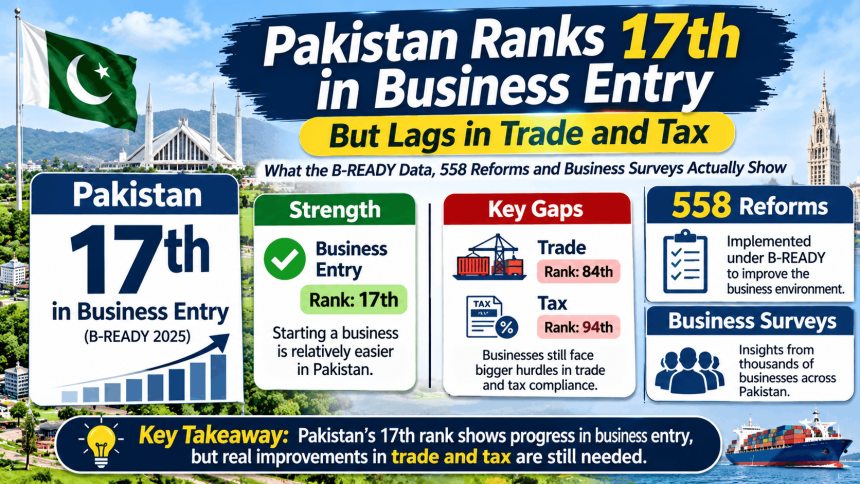
Ease of doing business in Pakistan is no longer measured by the World Bank’s old Doing Business ranking, which was discontinued. The current framework is the Business Ready (B-READY) assessment, and Pakistan’s performance is uneven. The country performs strongly in Business Entry (starting a company), where it ranks 17th out of 101 economies with a score of 86.64 . But it remains in the lower tiers overall, sitting in the fourth quintile in 2024 and a similar position in 2025, because of weaknesses in trade, taxation, and dispute resolution . This guide explains what the numbers mean, the reforms underway, and the practical experience of businesses on the ground.
The Shift from Doing Business to B-READY
The World Bank retired the Doing Business report in 2021 after data irregularities. Its replacement, B-READY, uses a different method. Instead of a single global rank, it scores economies across 10 firm lifecycle areas and places them in quintiles, balancing the burden on firms with social benefits like worker protections and environmental standards .
This change matters because Pakistan’s old Doing Business success stories no longer translate directly into the new system. The Pakistan Institute of Development Economics (PIDE) notes that the lessons from the Doing Business reform era “seem to have been lost over the past few years,” and that Pakistan’s 2025 B-READY scores “underscore the challenges facing the country” .
Where Pakistan Performs Well: Business Entry
Starting a company is Pakistan’s strongest area. The B-READY data shows that domestic firm registration takes 5 to 7 days, costing 3 to 5% of GNI per capita. Foreign firms face a similar timeline of about 7 days at 3% of GNI per capita. There is no minimum capital requirement, and the SECP’s electronic systems handle name verification, shareholder filings, and annual returns .
The SECP has continued to build on this. In September 2026, it approved measures to expand automated data sharing with the FBR, provide a single point of information for environmental permits, and publish gender-disaggregated statistics on company ownership . These are incremental improvements to an already strong area.
Where Pakistan Struggles: Trade, Tax and Disputes
The weak areas are where businesses feel the most friction.
International trade scores poorly. Export clearance takes 15 days, and import clearance takes 38 days. Compliance costs amount to 17% of shipment value. The PIDE analysis attributes this to limited Trusted Trader programmes, poor digital infrastructure at borders, and overlapping federal and provincial requirements .
Taxation is a persistent complaint. The regulatory framework for tax scores just 35.47 out of 100, with clarity and transparency at 7 out of 40. Firms deal with the FBR for income and sales tax, plus separate provincial revenue authorities (SRB in Sindh, PRA in Punjab, KPRA in Khyber Pakhtunkhwa, BRA in Balochistan) and municipal levies. PIDE estimates compliance alone consumes hundreds of hours yearly . The OICCI’s 2025 perception survey found that only 17% of investors viewed tax positively, and a striking 81% rated tax refunds adversely .
Dispute resolution is among the weakest categories, scoring around 40 out of 100. Court litigation historically took over 1,000 days, transparency is low, and alternative dispute resolution is underdeveloped .
The Government’s Reform Programme
The government is aware of these gaps. In July 2026, Prime Minister Shehbaz Sharif directed authorities to expedite implementation of the Ease of Doing Business Act, 2025. The meeting was told that work had been completed on 558 reforms, with 71 implemented and 272 under execution across seven phases. These measures are expected to generate estimated savings of Rs 468.7 billion for the business community by reducing compliance costs .
The Prime Minister also called for third-party validation by international organisations to assess whether the reforms are actually working . That is a useful caveat: the number of reforms announced is not the same as the experience of businesses on the ground.
What Businesses Actually Experience
The OICCI’s 2025 perception survey gives a grounded view. There are signs of progress. Positive perceptions of banking infrastructure rose from 41% to 58%, and access to local finance improved from 40% to 57%. The ease of opening letters of credit jumped from 6% to 41% after the foreign exchange shortage eased .
But the broader picture is cautious. The share of investors viewing Pakistan as a low-risk environment slipped from 6% to 5%. Utility reliability remains weak, and cross-border trade perceptions are still largely negative . The World Bank’s own programme document notes that reforms can generate social conflict risks, including resistance from actors who benefit from regulatory opacity and uneven access to new digital platforms for smaller and women-owned firms .
Frequently Asked Questions
What is the ease of doing business ranking of Pakistan?
Pakistan no longer has a single Doing Business rank because that report was discontinued. Under the replacement B-READY framework, Pakistan ranks 17th out of 101 economies in Business Entry but sits in the lower quintiles overall due to weak trade, tax, and dispute resolution scores .
Is the World Bank Doing Business report still published?
No. The Doing Business report was discontinued after data irregularities. The World Bank now publishes the Business Ready (B-READY) assessment, which uses topic scores and quintiles rather than a single global ranking .
What reforms has Pakistan made for ease of doing business?
The government has completed work on 558 reforms, with 71 implemented and 272 under execution. The reforms target reduced regulatory requirements and paperwork, with estimated savings of Rs 468.7 billion for businesses . The SECP has also approved automated data sharing with the FBR and a centralised information portal for permits .
What are the biggest problems for businesses in Pakistan?
The B-READY data points to international trade (38 days for import clearance, 17% compliance cost), taxation (fragmented federal-provincial system, poor refund experience), and dispute resolution (slow courts, weak ADR) as the main bottlenecks . The OICCI survey confirms tax refunds as the single most critical dissatisfaction, with 81% of investors rating them adversel.